



Continued cooperation with the National Energy Secretariat (SNE) of Panama
Following his support in elaborating the National Strategy for Rational and Efficient Use of Energy (ENUREE) of Panama, the director of Energy-Strategies was entrusted by the World Bank and SNE to advise on the development of specific actions to foster energy efficiency and environmental compliance of domestic appliances considered as priorities in order to reach the objectives of the Strategy: refrigeration and air conditioning equipment with low global warming potential (GWP) and energy efficient domestic cooking appliances.
While the elaboration of environmental standards and of a strategy for early replacement of refrigeration and air conditioning equipment are activities explicitely mandated by Action Lines No 21: ‘To develop global warming potential standards for refrigerant gases contained in refrigeration and air conditioning products’ and No 22: ‘To design and implement an early replacement programme for refrigeration and air conditioning equipment’, the elaboration of energy efficiency standards for domestic cooking appliances is implied by Action Line No 15: ‘Develop and issue technical standards and technical regulations for energy efficiency for all priority energy-related products’ of the ENUREE.
Development of Global Warming Potential (GWP) Standards for Refrigerants in Refrigeration and Air Conditioning Equipment
Based on a review of GWP indices and the legal framework for refrigerants contained in refrigeration and air conditioning equipment (RAC) internationally, a review of the legal and regulatory framework for reducing high-GWP substances in Panama, and an initial assessment of the availability of low-GWP refrigerants in international and Panamanian markets, as well as the costs and benefits of RAC equipment containing such refrigerants, viable GWP limits were proposed for the Panamanian market. Several options for including these indices in the regulatory framework for RAC equipment were evaluated, taking into account ENUREE’s mandate to implement GWP standards for refrigerants in domestic RAC equipment, and the national plans and regulatory framework in force for controlling high-GWP substances.
Design of a programme to accelerate the transition to efficient refrigeration and air conditioning equipment with low global warming potential
Based on a review of instruments and programmes for the transition to efficient refrigeration and air conditioning equipment with low GWP at the international level, as well as studies and projects, and the legal and regulatory framework relevant to the renewal of the stock of refrigeration and air conditioning equipment in Panama, alternative and/or complementary options for a programme to accelerate the transition to efficient refrigeration and air conditioning equipment with low GWP were proposed, selecting the most economical options considered feasible in Panama, including the savings targets, the required investments and the economic and environmental benefits of each option, taking into consideration the financing instruments available and proposed in Panama.
Both the GWP standards and the programme to accelerate the transition to efficient, low-GWP refrigeration equipment proposed were developed in close coordination with the public entities involved in implementing the Kigali Amendment to the Montreal Protocol, as well as the Electronic Waste Project in Latin America (PREAL), particularly the National Ozone Unit (UNO) of the Ministry of Health (MINSA) and the Ministry of the Environment (MIAMBIENTE), and related entities, as well as the Ministry of Commerce and Industries (MICI), whose responsibilities include assessing the conformity of products introduced into the national market. It was also based on the studies ‘Market Assessment for Refrigeration Equipment in Panama’ (May 2022) and ‘Economic Analysis of Various Market Transformation Programs in Panama’ (May 2023) and its supplement (August 2024), prepared by V. Letschert, consultant to the World Bank.
Energy Efficiency Standards for Electric and LPG Cooking Equipment
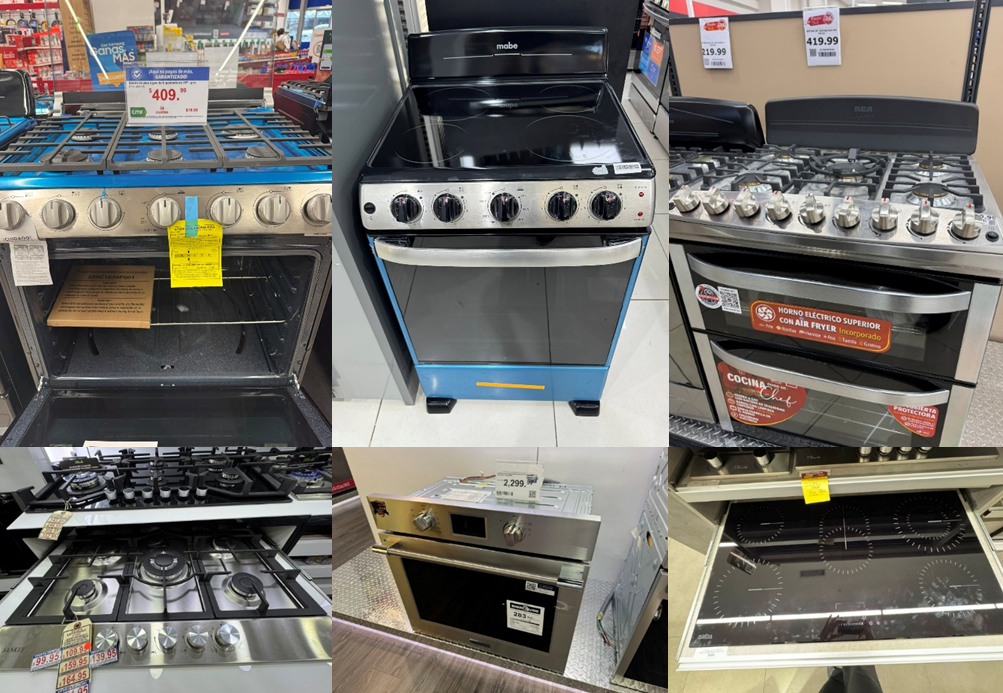
The objective of this consultancy was to support the National Energy Secretariat (SNE) in determining the current status of energy efficiency standards for electric and LPG cooking equipment and to design a plan for their regulatory implementation in Panama, covering the following domestic cooking equipment: (i) electric hobs (conventional and induction); (ii) gas hobs; (iii) electric and gas ovens; (iv) electric and gas ranges (appliances consisting of an oven and a hob).
The study was developed according to the following steps:
- Determine a general inventory of available electric and LPG cooking equipment in Panama, as well as the current regulatory scope;
- Identify international energy efficiency regulations and standards for LPG and electric cooking equipment for implementation in Panama;
- Analysis of the benefits for end users and for the government administration in terms of energy savings, costs, and sustainability.
- Development of a general implementation roadmap, key messages, lessons learned, and recommendations for next steps, including a proposed regulation.
The inventory of cooking equipment was investigated through a market study, focusing on the supply chain, trade flows, and the predominant characteristics of the equipment offered in the market and the stock of equipment in the households of the country, which are characterised by the predominance of equipment using LPG over electric equipment.
The identification of international energy efficiency standards for cooking equipment using LPG and/or natural gas and electricity, suitable for implementation in Panama, was developed through a screening of international regulations and standards, encompassing regulations from the European Union, the United States, and other Latin American countries with regional ties (Colombia, Costa Rica, and Mexico), as well as relevant international, regional, and national energy efficiency standards. To identify the most suitable regulations and standards for application in Panama, the following criteria were considered: (i) ambitious energy efficiency thresholds that result in maximum savings and minimum costs for consumers at the national level; (ii) internationally recognized regulations, relevant to the Central American region; (iii) testing standards aligned with international standards (ISO/IEC, EN/IEC); (iv) potential for international and/or regional harmonization.
Applying these criteria, regulations and standards in force in neighbouring countries were recommended for gas and electric hobs and ovens, respectively, taking into consideration the application of efficiency criteria and testing methods aligned with international best practices, which generally result in favourable economic and environmental indicators.
Finally, the proposed Roadmap includes the necessary steps for establishing a dialogue between the public and private entities involved, defining the levels of MEPS, developing the regulations and technical standards and their implementation, through the procedures established within the public administration, as well as communication, monitoring, and evaluation activities.
For more information please contact David Vilar at the World Bank or Liliana Morales at SNE Panama. The technical assistance provided by the World Bank was financed by ESMAP.
March 2026